

Lab News
Now get the latest CHARM Lab News via our Instagram!
May 2024
Congrats to Mary Kate, Sehui, and Melissa for passing quals!
April 18, 2024
Congratulations to Rachel Adénékàn for successfully defending her thesis: Feasibility of Using Smartphone Vibrations for Sensory Monitoring!


April 11, 2024
The research of former CHARM Postdoc Caitlyn Seim and collaborators is now featured in a Scripps News story. We thank participant Ho Wei Tsang and Neurologist Maarten Lansberg for participating in this news report!
April 2024
Many CHARM members attended IEEE Robosoft 2024. Rianna Jitosho, Cosima du Pasquier, Alexandre Thullier, and Max Ahlquist presented their technical conference papers. Allison gave a talk! Congrats to Cosima and her co-authors for being names as Best Demo Award Finalists.
April 2024
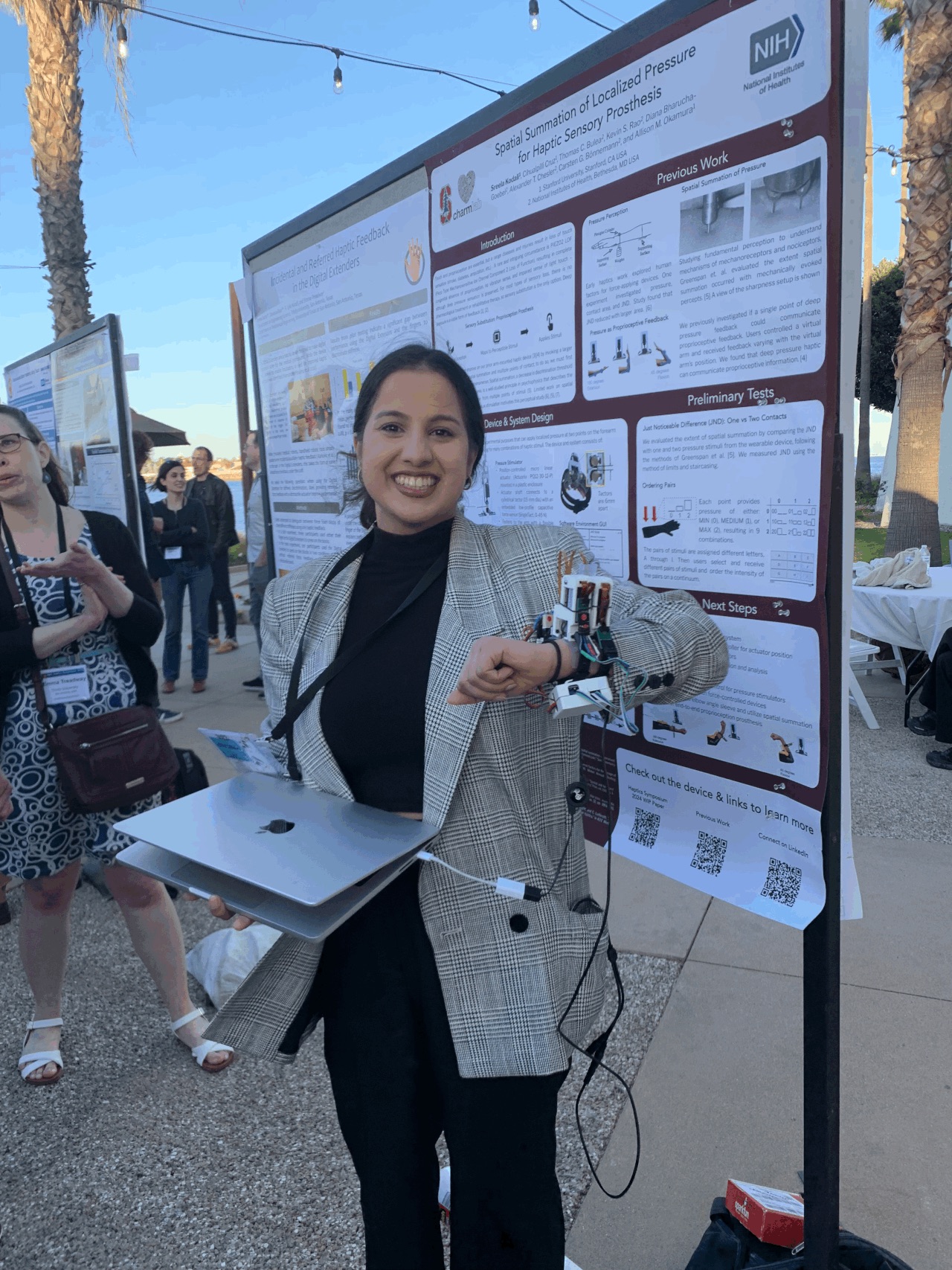
Many CHARM members attended IEEE Haptics Symposium 2024. Jasmin Palmer and Rachel Adenekan gave oral presentations of their technical conference papers. Sreela Kodali presented a poster for her Work-In-Progress Paper, and Allison Okamura gave a Cross-Cutting Challenge talk! Congrats to Rachel Adenekan and her co-authors for being named as Best Paper Award Finalists!


August 2023
Kyle Yoshida successfully defended his thesis: Design and Perception of Mobile Tactile Displays!


August 2023
Nathaniel Agharese successfully defended his thesis: Modeling and Interfacing with Vine Robots!


August 1-3, 2023
The CHARM Lab enjoyed a retreat at Emigrant Gap / Donner Lake / Lake Tahoe. We did some team building, professional development, and lab improvement activities, and also had fun hiking, adventuring (including zip lining), in the water, and plating games in the house.


August 2, 2023
Congrats to CHARM visiting student Liana Tilton and her collaborators making robot dogs, for their demonstration of mechanical pets at Lucile Packard Children’s Hospital (LPCH) at Stanford Medicine.

July 10-13, 2023
Congratulations to CHARMers and CHARM alums who presented their work at the 2023 World Haptics Conference and associated workshops in Delft, Netherlands! Technical Paper Presenters include Kyle Yoshida and Sreela Kodali. Cosima du Pasquier, Jasmin Palmer, and Kentaro Yoshida presented demos with assistance from Brian Vuong. Jasmin also participated in a panel on Multisensory Cutaneous Haptic Displays. We also met up with CHARM alums Mine Sarac (Kadir Has University), Fabio Stroppa (Kadir Has University), Cara Nunez (Cornell University), Heather Culbertson (University of Southern California), Hyeonseok Seong (KAIST), and their lab members!


June 2023
Congrats to all the CHARM graduates from this year: Yimeng Qin, Nathaniel Agharese, Catie Cuan, Kyle Yoshida, Brian Do, Brian Vuong, Millie Salvato

April 2023
Brian Do successfully defended his thesis: Variable Stiffness and Shape-Changing Robots!

April 3-7, 2023
Congratulations to CHARMers and CHARM alums who presented their work at the 6th IEEE-RAS International Conference on Soft Robotics (RoboSoft 2023) in Singapore! Technical Paper Presenters include Rianna Jitosho, Sofia Simon-Trench, Sebastian Urdaneta-Rivera, Brian Do.
Congrats to Yimeng Qin, Rianna Jitosho, Alex Kübler, Sebastian Urdaneta-Rivera and Sofia Simon-Trench on placing third in the Terrestrial Race Challenge!

Congrats to Alex Kübler, Sebastian Urdaneta-Rivera and Frances Raphael on winning Best Video for their work: A Multi-Segment, Soft Growing Robot with Selective Steering

We also got a chance to meet up with CHARM alums and their lab members!

March 30, 2023
Allison is featured on the Wu Tsai Neurosciences Institute podcast, “From our Neurons to Yours.” She is interviewed by Nicholas Weiler and talks about virtual touch and its connection to neuroscience.
March 2023
Catie Cuan successfully defended her thesis: Supervised Learning for Compelling Robot Behaviors!

February 8, 2023
Congratulations to CHARMers who presented their work at the eWear annual symposium! Presenters include Rianna Jitosho, Kyle Yoshida, Rachel Adenekan, Brian Do, and Jasmin Palmer. Congratulations to Brian Do for winning the best poster presentation award!


January 27, 2023
We are greatly saddened by the passing of our collaborator Prof. Krishna Shenoy, who was an extraordinary person and scientist. Please see this article for details about Krishna.

December 9, 2022
We are thrilled that our project "Appropriate Rehabilitation Technology via Passive Tactile Stimulation" was selected for NSF's Convergence Accelerator program. We aim to create low-cost, portable, take-home wearable technology for recovery of movement to enhance quality of life as well as employment opportunities for persons with movement disability after stroke.
NSF's Convergence Accelerator is developing use-inspired solutions to enhance the quality of life and employment opportunities for persons with disabilities. Through a $12 million investment, NSF has selected 16 multidisciplinary teams for the program's Track H: Enhancing Opportunities for Persons with Disabilities. Track H builds upon the Convergence Accelerator's mission of accelerating convergence research to address large-scale societal and economic challenges. Learn more about this announcement at: https://bit.ly/3j4SRAV.

December 1, 2022
Hoover Institution director Condoleezza Rice announced the Fall 2023 publication of The Stanford Emerging Tech Review, a new multidisciplinary collaboration in which scholars and experts from Stanford will summarize contributions of university researchers in areas of critical technology over the past year. In addition to advising US government officials and private-sector leaders on recent advances at Stanford in key technology areas, the first annual publication of The Review will examine the potential challenges, opportunities, and consequences of their use. Allison Okamura will lead the Robotics sector in the review.
November 30, 2022
Brian Do and Godson Osele’s TapeBot was featured on IEEE’s Video Friday.
November 28, 2022
Millie Salvato successfully defended her thesis: Data-driven methods for improving social interaction in virtual environments!

November 18, 2022
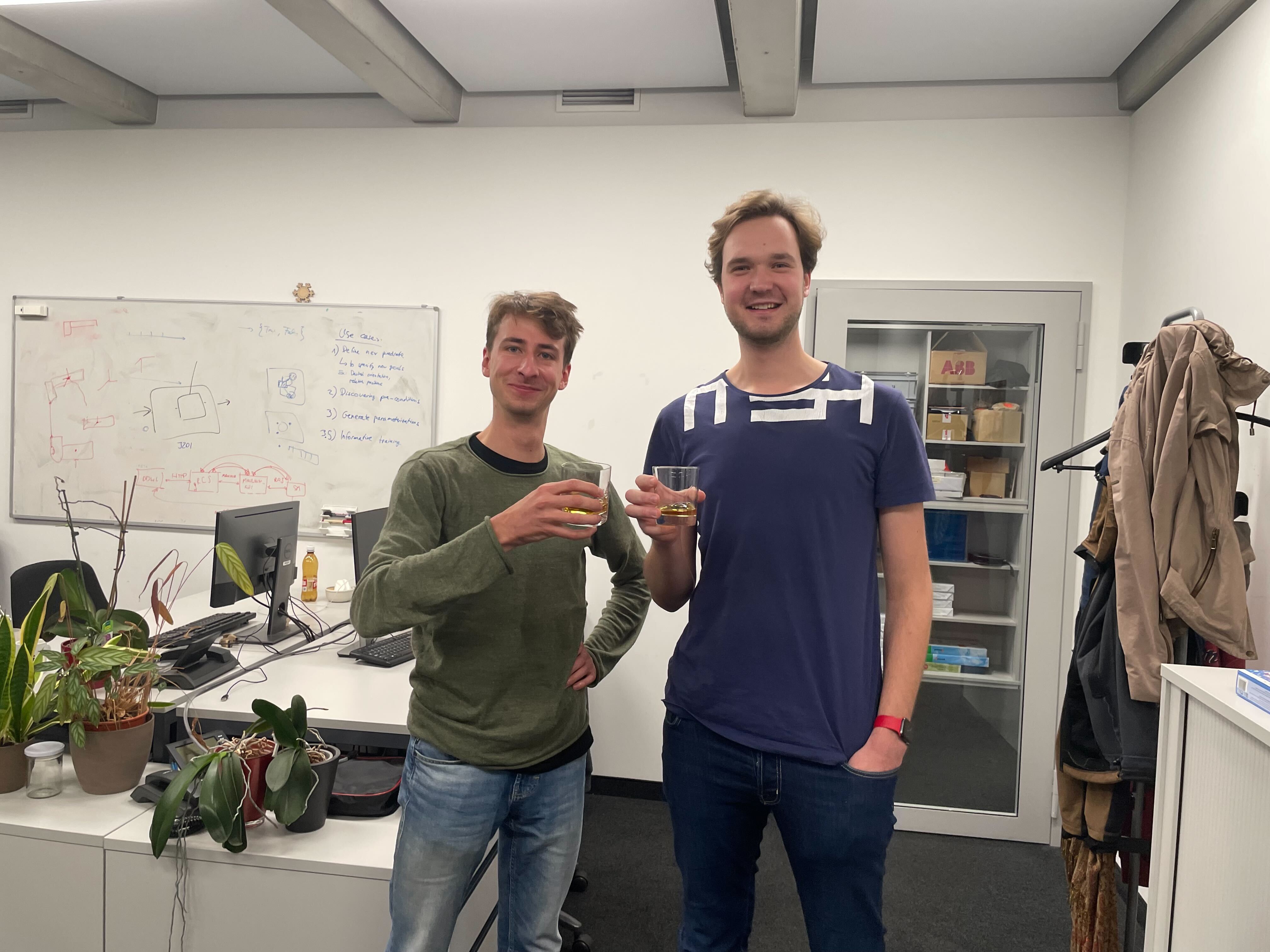
Visiting student Alexander Kuebler celebrates the completion of his thesis with his colleague at ETHZ. Congratulations Alex!
November 17, 2022
Godson Osele presented his work at the SystemX Robotics Fall conference.

November 15, 2022
Catie Cuan presented her work at the 2022 HAI Fall Conference on AI in the Loop: Humans in Charge.


November 4, 2022
Congratulations to CHARMers Catie Cuan and Nathaniel Agharese for presenting their work at the 2022 Bay Area Robotics Symposium in Berkeley! Allison also presented the lab's work on wearable haptic devices.


October 27, 2022
Congratulations to CHARMers and CHARM alums who presented their work at the 2022 IROS conference and associated workshops in Kyoto! Presenters include Cara Nunez (Harvard/Cornell), Jasmin Palmer, Nathaniel Agharese, Zonghe Chua (Case Western Reserve), Mine Sarac (Kadir Has), and Allison Okamura. We also met up with CHARM alums Tania Morimoto (UC San Diego), Margaret Coad (Notre Dame), Cara Welker (University of Michigan/University of Colorado Boulder), Nathan Usevitch (Facebook Reality Labs), Sajid Nisar (Kyoto University of Advanced Science), and their lab members.


